Engaging All Learners

Engaging All Learners
Studio Day April 2019

Wednesday, February 17, 2016

Analyzing Data at Paine Primary

Over the next week, all teachers at Paine Primary will meet with the reading and math coaches to analyze their students' data.  STAR and STAR Early Literacy are used to assess reading progress;  STAR Math and Global Scholar are used to assess progress in math.  

Teachers look for strengths and struggles in their classrooms.  They look for the rate of growth between August and January.  They will create a plan to help students who are not growing as much as they would expect.  Teachers are asked to consider these questions as they look at their students' reading data:
  • What do we KNOW as a result of examining these data?
  • What do we THINK (hunches) as a result of examining these data?
  • What do we WANT to know as a result of examining these data?
  • How can we USE these data for instructional decision-making?


Reading Nonfiction

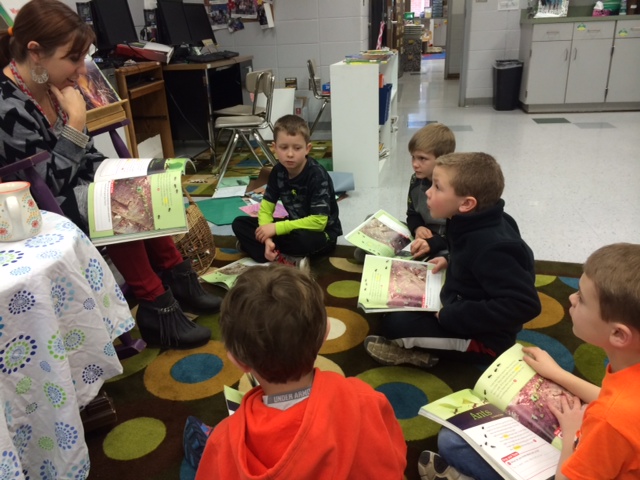
Second grade teachers are using nonfiction texts to prepare students to read and understand complex texts.  

Mrs. Johnson models questioning and finding evidence in an informational text about ants.  

Mrs. Rish has students closely read a complex article about U.S. Presidents.  This involves careful reading, reflecting, questioning, and rereading.  

Why is nonfiction reading important for kids?

By Alice Bouis – Marketing Manager News-O-Matic, The Daily News App For Kids 

On average, kids today spend less than 4 minutes a day reading nonfiction. Yes, 4 minutes. What can you actually read in 4 little minutes? How much can you truly understand and feel comfortable talking about later?

It is common knowledge that how much a child reads is important. Kids who read more will perform better, acquire a greater vocabulary and develop better critical thinking skills. However, what a child reads is also important. Statistics show that kids actually read an average of 25 minutes a day (which is very low compared to the 4 hours and 29 minutes a day they spend watching TV). Of those 25 minutes, just 4 are spent on nonfiction. But is that enough? How can reading nonfiction really help?

A study by Marzano underlined that nonfiction reading helps kids develop background knowledge. You might be thinking, “So what?” Well, that same study shows that background knowledge actually accounts for 33% of the variance in student achievement.

Educators now commonly assert that reading more nonfiction early on tremendously helps children reach the appropriate reading levels in later grade.  An interesting report from ACT in 2006, Reading Between the Lines: What the ACT Reveals About College Readiness in Reading, states that “the clearest differentiator in reading between students who are college ready and students who are not is the ability to comprehend complex texts.” According to experts, nonfiction is a great way for kids to develop critical thinking and analytical skills and, you guessed it, the ability to read and understand complex texts.

Check out this YouTube video about nonfiction text.
https://www.youtube.com/watch?v=1wyI_n20-SU 

Tuesday, February 16, 2016

Listening to High School Students

Dr. Jennifer Cardwell has made it a practice at HTHS to meet with students on a regular basis to ask for their input.  Student voice is an important part of the decision making process.  Last week at her Academic Learning Lunch, Dr. Cardwell invited randomly selected students to have lunch with her and to talk about next-steps that could positively impact students' learning experiences for 2016-17.  Here are some of their comments:

What are the positive learning experiences you’ve had at HTHS?  What are opportunities we provide that you think must be available next year, as well?
• Academies (multiple students said this)
• New perfect attendance recognition program
• Technology-use in the classroom
• Many students commented on accessibility of Chromebooks through library and their classrooms
• Rigor in advanced courses
• Calculators the library allows students to check out
• ACT prep that English and some math teachers conduct (several students even gave a shout-out to Leslie Terrell specifically)
• Remind 101 use (many freshmen commented on this)
• The way their teachers use Google Classroom
• The EMS program, specifically
• Co-Op
• Liked how some teachers were using learning targets to make students aware of what they were to learn during the lesson; multiple students referenced Dr. Stull’s Learning Targets and tests matching those – the students appreciated that
• Over and OVER students talked about how they appreciated their teachers who took the time to get to know them.  Relationships were emphasized repeatedly.

What are some ideas to consider for next year?
• Engineering classes are great but crowded – more sections of Engineering
• If a teacher makes an assignment that is a large project, should consider giving time frame that would include a weekend in case students have busy work or athletic schedules during weeknights.
• Students without cell phones can’t access Remind101; make sure there are other forms of communication with students
• If a student takes Physics, should have had Algebra II with trig first so course won’t be so difficult.
• “Some of my general courses could be a little more difficult – some of mine go too slowly” (to which Dr. Cardwell replied that the student should have been in more advanced courses, maybe…he agreed)
• Would like more CTE courses, like welding and cosmetology.  Explained how Co-Op could fulfill some of that for them.
• Would like student buses to long-distance away games
• Would like to see a pep rally for any team that makes it to state

According to Dr. Cardwell, "The students spoke so positively about many of their classes and teachers.  We have amazing students who really are interested in learning, and who desire that their teachers know them as individuals.  If you’ve never conducted student surveys in your classrooms to get feedback on your course, I encourage you to do that (Google Form is great).  Students like knowing their opinions are valued. Overall, our students are very appreciative of their educational experiences at HTHS, thanks to each of you."


ACT Interim Science Assessment

Third, fourth and fifth graders have recently completed ACT Interim Assessments in Math, Reading, and Science.  After taking the ACT Science Interim Assessment, fifth grade science teacher Ryan Hook had her students reflect on what the hardest part was and what they need to work on in order for students to feel more comfortable.  Here is what they said:

The hardest part was when we had to figure out data that was not there.
I think we need to deal more with graphs and find data from graphs.
I did not expect decimals.
We should study more diagrams.
I think we should start focusing more on math in science.
The hardest part of the test was trying to get centimeters.
To do better on the test, I would like to practice math with science.
The hardest part was graphs.
To do better, we should work more with graphs.
The hardest part of the test was math.
To do better on the test, we need to do more math and science.
To get my score up, we could work more on the tables and graphs.
The hardest part was the illustrated graphs.
To do better on the test, we should go over diameter and graphs.
We could do more with graphs.
We could practice tables more.
We could maybe work with graphs to do better on the test.

It isn't a surprise that so many students wrote about math as the number one thing they need to focus on.

From:  2016 Alabama Course of Study: Science
The main goal of the Alabama course of study for science is to give all Alabama students a solid foundation in science and engineering.  This course of study includes the most current scientific and engineering practices, cross-cutting concepts, and disciplinary core ideas our students need in order to become college and career ready.  

It is obvious that our standards and assessments call for far more than rote memorization of scientific facts.  Science is problem solving, and our students must be equipped to solve problems all day long throughout their lives.  Our students are aware that they will be required to think, use mathematics, and problem solve in science classes, on assessments, and throughout their lives.  

Wednesday, February 10, 2016

Science Training at NASA

Five TCS teachers were selected to participate in three-day NASA Institutes at Marshall Space Flight Center in Huntsville.  The goals of the training are to strengthen understanding of the new science course of study, to provide resources for teaching the science standards, and to develop a Learning Community network of educators throughout the state with the potential to maximize student success in science learning.

During the three-day NASA Institutes, participants are trained by education staff in the use of NASA education products specific to their grade bands and aligned to the new Alabama Course of Study: Science, tour the Marshall Space Flight Center and the U.S. Space and Rocket Center Museum, and develop model lessons and units.  Participants also hear about real-world applications of the standards through discussion-style presentations by NASA subject-matter experts in science and engineering.  Each day includes time for processing of the given information and for collaboration with grade-band colleagues from around the state to prepare model lessons and units incorporating the NASA resources.

Tuesday, February 9, 2016

Third Graders Study Fossils

Andrea Moore's third graders have been studying how fossils provide evidence of organisms and the environments in which they lived long ago. Students are enjoying being paleontologists and  finding the fossils of shells, shark teeth, and other items buried in plaster of Paris. This activity led to the conclusion that these fossils mostly likely indicate an ocean habitat of long ago.


Quotable Quote

A mission statement is meaningless if you and your team aren't on a mission. Know your why.