Engaging All Learners

Engaging All Learners
Studio Day April 2019
Showing posts with label Educator Effectiveness. Show all posts

Sunday, February 11, 2018

TCS Admins Collaborate to Learn

Principals, assistant principals, central office administrators, academic coaches, and teacher leaders met February 7 for the TCS Administrator Collaborative.  Objectives of the Collaborative Meetings are to:

  • Read, discuss, and share strategies from Learning That Lasts by Ron Berger
  • Develop a clear understanding of the TCS Educator Effectiveness Plan
  • Share ways we are facilitating professional growth and building expertise of the TCS Nine Indicators for Effective Educators
  • Participate in classroom walkthroughs with debriefing discussions to improve practice
  • Share walkthrough updates and data from each school
  • Determine Professional Development Needs and develop the TCS Professional Development Plan

The purpose of this professional study is:

  • To improve student learning
  • To improve teacher practice
  • To implement an evaluation model that aligns with instructional focuses and guides stakeholders in shared understanding of a research based, K-12, Educator Effectiveness model

The Learning Targets for February 7 were:
I can establish a math growth mindset culture in my school/district.
I can internalize my role in leading the shift in mathematics instruction in my school/ district.
I can recognize effective instructional practices in the learning of mathematics.  
I can reflect and update the district’s continuous improvement plan and professional development plan.


Monday, September 25, 2017

Walkthroughs Across TCS

According to Kachur, Stout, and Edwards in their book, Engaging Teachers in Classroom Walkthroughs, walkthroughs are a valuable tool for continuous improvement of schools. Walkthroughs are brief, frequent, informal, and focused visits to classrooms by observers for the purpose of gathering data on educational practices and engaging in some type of follow-up.

TCS principals, assistant principals, academic coaches, and central office personnel regularly engage in walkthroughs.  We encourage teachers to join in walkthroughs as this practice is a valuable source of professional growth for teachers at every stage of their careers.  Walkthroughs provide a means for teachers to observe, reflect on, and discuss their practices and to focus on individual, collegial, and schoolwide improvement.

Last week, walkthroughs in TCS classrooms yeilded important data and affirmation.  We are focusing on the nine TCS Educator Effectiveness indicators and on the impact of professional development that the district is providing.


Mrs. Bramlett Leads Number Talks 

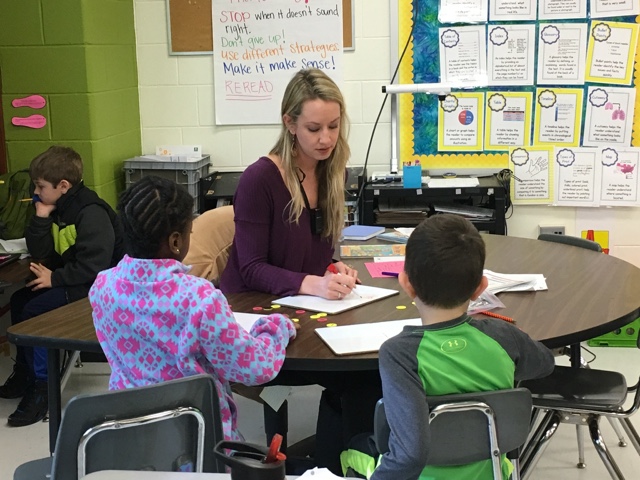
Mrs. Moore Confers with a Student about their Reading 

Music with Mr. Byars 

Mrs. Evans' Kindergartners Are Building Reading Stamina

Mrs. Sing's Kindergartners Learning to Write and Tell Stories

Students in Ms. Coleman's Class Participate in Socratic Seminar to Discuss "Story of an Hour"

Mrs. Johnson Confers with Second Graders about their Reading Progress

Time for Independent Reading in Mrs. Odom's Class

Rhythm Activity with Mrs. Fortenberry

Mrs. Camara Utilizes Manipulatives to Demonstrate Decimals

Mrs. Brasher's Students Stopping to Predict and Discuss Part of a Readaloud

Rigorous Problem Solving in Ms. Bresnan's Class

Maki Maki Club at HTMS

Data Display for Students at HTMS


Monday, June 12, 2017

TCS Administrators Reflect on 16-17 and Prepare for 17-18

TCS administrators and leaders met June 7 to reflect on the 16-17 school year and to think ahead to 17-18.

Learning Targets
  1. I can reflect and share top three initiatives or highlights from each school or department.
  2. I can reflect on 16-17 data and share with district colleagues.
    1. Attendance/Discipline
    2. Performance Series/STAR
    3. Other
  3. I can reflect and revise Educator Effectiveness.
  4. I can reflect on and revise the District Continuous Improvement Plan.

The first part of the day focused on data reflection. Mandi Logan and Kathy Burgin gave an attendance summary for unexcused absences. The data shows that new procedures that were put in place positively affected unexcused absences. Hal Riddle gave an update on discipline data for the district. Each School shared academic data and highlights of 16-17.

The administrators reflected on Educator Effectiveness for 16-17, answering what went well and what needed to be changed.

The group revised the district Continuous Improvement Plan, reflecting and discussing the progress made toward achieving the nine goals and needed improvements.


Tuesday, January 31, 2017

Rigorous and Relevant Assignment Commemorates First 100 Days at Magnolia

Take a look at the rigorous and relevant writing assignment Mrs. Jackie Moore has assigned her fifth grade students to commemorate the first 100 days of Magnolia Elementary!  The students' reflection papers will be displayed in the hallway for all to read and enjoy. The writing assignment below gives information and instructions for the First 100 Days of School Reflection paper.

Instructions:
1.    Write a reflection paper in 100 words about your school events, school field trips, and what you have learned in the first 100 days of this school year.
Examples of writing topics to place within your paper:
a.     School related events (Magnolia Elementary Picnic on the Grounds with your families  before we left Paine Elementary, the opening of our new school at Magnolia Elementary School,  Winter Wonderland, Awards Day programs,  the outside ceremony when our new American flag was presented and then raised at our new school, Magnolia Elementary School, etc.)
b.    School field trips (Field trip to Cabaha Environmental Center)
c.     Topics you learned in each of your three academic classes: Reading, Writing, Math, Science, Social Studies
2.    Write a rough draft of your reflection before you write your final paper. (Keep your draft in the writing section of your Literacy Binder.)
3.    You may write your final paper in cursive or you may type it.
4.    Make sure you write a creative title at the top of your reflection, by including, My First 100 Days of Fun and Learning.
5.    Your paper needs to be free of mistakes in spelling and capitalization.
6.    Make sure your sentences are complete sentences with end punctuation.
Your final First 100 Days of School paper will be displayed in the hallway, so make sure your content in your reflection paper relates to the examples mentioned above and make sure the instructions that are listed above are followed. 


Thursday, January 26, 2017

TCS Administrators Learn Together

TCS administrators, along with TCS Curriculum and Instruction staff, joined together to complete walkthroughs at HTMS and Magnolia Elementary for the purpose of collaborating and utilizing observation rubrics developed by teachers and leaders of Trussville City Schools.  The group observed in classrooms together and shared data they collected in order to develop a shared understanding of the attributes and actions associated with the nine instructional strategies that make up the TCS Educator Effectiveness Plan.  The primary purpose of the Educator Effectiveness Plan is to support growth in instructional practice that will ultimately lead to continuous improvement and an increase in student performance.

The group debriefs after visiting classrooms at HTMS.

The focus of the walkthroughs at HTMS was on learning targets.  Teachers at HTMS are working to frequently facilitate interaction between students and learning targets and to provide opportunities for student collaboration and discourse as a means of self-assessing the learning target.  

Teachers require students to use learning targets to self-assess.  Through this self-assessment, students will become more accountable for their own learning and work.  Students will be able to communicate their needs regarding their level of understanding about the learning target.  

HTMS teachers have developed Quality Questions that are connected to the learning targets.  

Above, HTHS principal, Tim Salem, observes a social studies lesson in Mr. Reynolds' class.  
Students read an article about The Great Depression and were asked to cite textual evidence to support analysis of what the text said explicitly as well as inferences drawn from the text.  

Math teacher, Charlotte Booker, displays her students' learning target as well as her plans for the day.  Notice that their "Daily Math" is based on data from a prior mini quiz.  After self-assessing, students will complete a plan for achieving the learning target.  

Administrators observed intervention at Magnolia.  Intervention is a time when teachers work with individuals or small groups to provide targeted, specific intervention.  Above, Lauren Long, computer teacher, is orienting a small group of students who will begin a book club that meets daily with her. 

Mrs. Hodges works with two students on reading skills.

Dr. Cardwell listens in as a student reads independently while his teacher works with a small group of students who need targeted assistance.

Ms. Dykes helps students with math during her intervention.

Mrs. Gamble pulls a group to work on math skills while her other students work independently using iPads.  

Tuesday, January 24, 2017

Paine Teachers Collaborate to Learn

Paine Elementary teachers collaborated Monday during the professional learning time to learn more about using learning targets in their lessons.  The session was facilitated by academic coaches, Kelly McGough, Edra Perry, and Jana Walls.

According to Ron Berger's Leaders of their Own Learning, learning targets help students define what they are learning and why they are learning it, enabling them to monitor their progress toward the learning goal.  Even well-written learning targets will contribute little to engaging, supporting, and holding students accountable if they are not referred to and used actively during the lesson.  In addition to frequent checks throughout the lesson, the end of a lesson is also an important moment for checking for understanding.  A well-constructed debrief will enable students to reflect on their learning, returning to the day's learning target to assess their progress.

The use of learning targets is important to teachers in TCS and is one of nine indicators that the Educator Effectiveness Team included as a strategy effective teachers use routinely.  Ideally, goal oriented learning targets are consistently posted with higher level verbs.  Teachers develop and clearly communicate the connections between content standards and the knowledge and skills being taught. Learning targets enable learners to set and monitor academic and behavioral goals with instructional activities.  Teachers utilize learning targets as a formative assessment that drives instruction.

Mrs. Brasher shares information from her group.

Assistant principal Donna Brumlow learns alongside Paine teachers.

Assistant Principal Catherine Finkley is a member of the learning community at Paine.


Principal Tygar Evans is in the work with teachers, learning how to utilize learning targets.


Monday, December 12, 2016

Supporting Rigorous Reading

Teachers throughout the district are expecting students to read and comprehend text that is much more rigorous than what has been taught in the past.  Teachers aren't just handing out harder books. Teachers are reading and studying, themselves, so that their instruction will provide the necessary support students need in order to read and comprehend rigorous texts.  Kindergarten through fifth grade reading teachers are using Lucy Calkins' Units of Study for Teaching Reading to guide their instruction.  

Last week at Magnolia Elementary, Dr. Jeter, Kelly McGough (reading coach), and I observed a reading lesson in Teresa Biven's second grade classroom.  Second grade teachers have recently introduced their nonfiction unit, a critical component of reading instruction.  According to Doug Lemov, author of Reading Reconsidered, reading more nonfiction is important, but reading nonfiction more effectively in a way that unlocks knowledge and increases engagement and appreciation is just as important.  Because reading nonfiction requires very different skills than those necessary for reading fiction, Mrs. Bivens began by asking her students to examine shiny pennies, while noting what they noticed, wondered, and learned through their careful examination.  It was amazing to hear the students ask about the dates on their pennies, why Lincoln was not wearing his hat, what building is on the back of the penny, etc.  

Next, Mrs. Bivens divided students into small groups and asked them to go to four stations that included a model of a heart, a map of Trussville, a globe, and nonfiction big books.  The objective was to notice, wonder, and learn by carefully examining the objects and texts.  Again, it was surprising to see how much the students could learn on their own through deliberate, careful exploration and attention to details.  

Finally, students were provided bins of books that were appropriate for their reading levels and asked to pick a book to carefully read and examine.  Again, students were expected to notice, wonder, and learn as they applied these reading skills to an interesting nonfiction book.  

The lesson was an example of the effective lessons that are being planned and implemented throughout the district. Mrs. Bivens provided a thoughtful, challenging lesson that began with a student-friendly learning target, based on standards.  Academic vocabulary words (i.e. examine and  analyze) were introduced to the students.  Instruction was differentiated by the provision of books based on individual reading levels.  Throughout the lesson, student and teacher discourse was evident, as well as student to student discourse.  Students were engaged throughout the lesson with very few distractions because expectations and procedures were clear and in place.  Best of all, the culture of the classroom was academic and positive.  It was obvious that the students valued learning and were willing to commit their time and attention to the tasks in order to learn.  

Many thanks to Mrs. Bivens for sharing her classroom to administrators as we learn together.  

The learning target (above) was reviewed with students at the start of the lesson and referred to throughout the lesson.

Mrs. Bivens created a PowerPoint to help guide her instruction.

Students were given pennies to examine and asked to notice, question, and learn.


Students examined a map of Trussville.

Students explored a globe.

Mrs. McGough listened as students read nonfiction text.


Dr. Jeter observed students who examined a life-size model of the heart.

Instructions were clearly shared with students.

Bins of books were assembled prior to the lesson to provide "just right" levels of nonfiction books for all students.  

Students read independently, noting things they noticed, questions, and new learning.