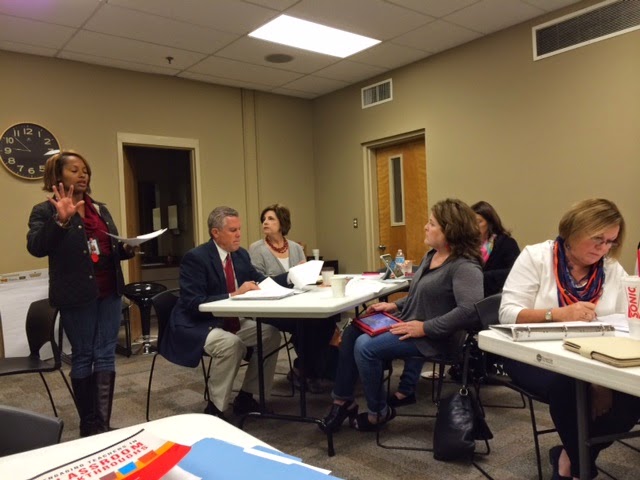
I attended a CASEE (Central Alabama Science Education Exchange) meeting today with other curriculum directors in our area. CASEE is lead by ALAHASP at UAB CORD facilitators, Beverly Radford and Joan Dawson. Information we received:
- New Science Standards most likely will not be forthcoming until 16-17.
- Area schools are beginning to study and understand the Next Generation Science Standards and the National Research Council's Framework. (These are NOT standards adopted by the ALSDE, but can serve as a guide to what the upcoming standards may look like.)
- The shift is to STEM (Science, Technology, Engineering, and Math). Next summer, UAB will offer science workshops for teachers led by Ann Dominic, one of the area's most well-known MATH teachers!
- The Birmingham Botanical Gardens have Discovery Field Trips for grades K-5 that focus on botany. Middle school field trips have an emphasis on plant systems, sustainability, technology, and conservation. They have open dates for winter and spring.
- Cahaba Environmental Center near Montevallo will open in March 2015. This facility includes 440 acres along the Cahaba River in Bibb and Shelby Counties with residential facilities including cabins, dining halls, and indoor classrooms, for visiting groups. The Cahaba River and its watershed are the thematic core of the educational program. The initial program is being developed to meet the educational needs of 4th-6th grade students. The program is being designed to encompass a 3 day/2 night experience. Longer and shorter programs will also be available.
The National Research Council's (NRC)
Framework describes a vision of what it means to be proficient in science; it rests on a view of science as both a body of knowledge and an evidence-based, model and theory building enterprise that continually extends, refines, and revises knowledge. It presents three dimensions that will be combined to form each standard:
The practices describe behaviors that scientists engage in as they investigate and build models and theories about the natural world and the key set of engineering practices that engineers use as they design and build models and systems. The NRC uses the term practices instead of a term like “skills” to emphasize that engaging in scientific investigation requires not only skill but also knowledge that is specific to each practice. Part of the NRC’s intent is to better explain and extend what is meant by “inquiry” in science and the range of cognitive, social, and physical practices that it requires.
Although engineering design is similar to scientific inquiry, there are significant differences. For example, scientific inquiry involves the formulation of a question that can be answered through investigation, while engineering design involves the formulation of a problem that can be solved through design. Strengthening the engineering aspects of the Next Generation Science Standards will clarify for students the relevance of science, technology, engineering and mathematics (the four STEM fields) to everyday life.
Crosscutting concepts have application across all domains of science. As such, they are a way of linking the different domains of science. They include: Patterns, similarity, and diversity; Cause and effect; Scale, proportion and quantity; Systems and system models; Energy and matter; Structure and function; Stability and change. The Framework emphasizes that these concepts need to be made explicit for students because they provide an organizational schema for interrelating knowledge from various science fields into a coherent and scientifically-based view of the world.
Disciplinary core ideas have the power to focus K–12 science curriculum, instruction and assessments on the most important aspects of science. To be considered core, the ideas should meet at least two of the following criteria and ideally all four:
- Have broad importance across multiple sciences or engineering disciplines or be a key organizing concept of a single discipline;
- Provide a key tool for understanding or investigating more complex ideas and solving problems;
- Relate to the interests and life experiences of students or be connected to societal or personal concerns that require scientific or technological knowledge;
- Be teachable and learnable over multiple grades at increasing levels of depth and sophistication.